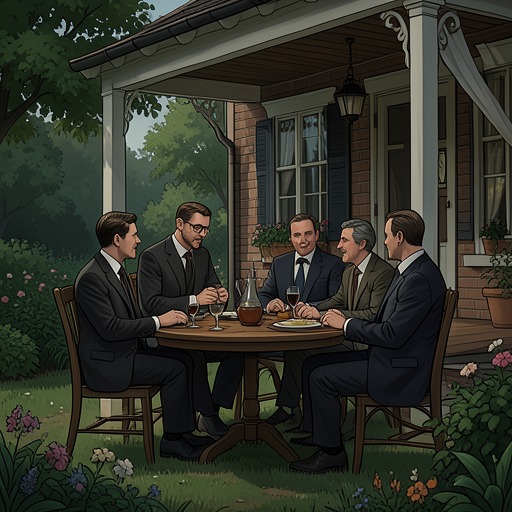
M. Verdurin
In Search of Lost TimeM. Verdurin, known as the Boss, governs the social world of his household through a combination of theatrical hospitality, sharp-edged judgment, and control over who belongs. At La Raspelière, the death of the pianist Dechambre exposes the cost of that authority: the host acknowledges affection for the dead man, yet tries to keep grief out of the evening’s conversation and dinner moving. His treatment of Saniette and his classification of artists and guests likewise show how the Verdurin circle’s apparent informality rests on rules he enforces.
Identity and Social Position
M. Verdurin is the host at La Raspelière, where he greets the arriving guests on the steps and takes pleasure in seeing the faithful dressed for dinner. When the narrator apologizes for not having changed, M. Verdurin reassures him that everyone is among friends and jokes that one of his own dinner-jackets would not fit. The welcome is generous in manner, but M. Verdurin’s role is not merely to receive guests: his attention to who is present, how they are dressed, and what may be said helps establish the terms of the gathering.
His authority is exercised alongside his wife’s, but it is not identical to hers. He describes her as morbidly sensitive and insists that speaking of Dechambre’s death might make her ill; at the same time, his impatience and irony make clear that he resents having to manage her distress. Their continuing union does not prevent his frequent criticism of her. His account of her grief is therefore also an act of self-presentation: he casts himself as the practical person who must protect the household from an emotion he finds inconvenient.
Dechambre’s Death and the Dinner
Brichot enters the house with an emotional handclasp intended as condolence for the death of Dechambre, but M. Verdurin gives no answering sign of mourning. When Brichot cautiously brings up the dead pianist, M. Verdurin calls the subject futile and urges him to remove his things because a bouillabaisse should not be kept waiting. He then warns Brichot not to mention Dechambre in front of Mme Verdurin, claiming that she nearly wept at the news and might make herself ill again, only three weeks after bronchitis. In the same breath, he says that he was fond of Dechambre but is fonder still of his wife.
The sympathy is real enough to be claimed, but M. Verdurin dictates its permissible form: Brichot may think of Dechambre, but must not speak of him. That demand turns private remembrance into a household matter over which the host asserts jurisdiction. Cottard’s warning that distress could give Mme Verdurin a temperature of 102 adds a medical-sounding rationale, while the narrator’s observation that medicine can change the sense of verbs and pronouns exposes how care may become an instrument for suppressing grief.
M. Verdurin goes further when Brichot continues to praise Dechambre. He objects that death is no reason to make the pianist a genius: Dechambre played well, he argues, but depended on the surroundings in which Mme Verdurin had made his reputation. Transplanted elsewhere, he would have ceased to exist. M. Verdurin says Dechambre had recently needed to practise scales before concerts just to recover his wrist suppleness for a short time, and pointedly suggests that his death came at the right moment for his reputation. The cruelty of the judgment sits beside the earlier claim of affection, revealing how quickly the Boss converts a dead friend into a verdict about artistic standing.
Dinner remains the evening’s governing priority. M. Verdurin compares the expected perfection of the lobsters, grilled according to Pampille’s recipe, with his impatience at Brichot’s lamentations, and refuses to let the company go hungry because Dechambre has died. He announces that the guests will hear, or at least meet, Morel, whom his wife has discovered and whom he calls a greater artist than Dechambre. Morel is delayed, so M. Verdurin plans to send a carriage to meet the last train; he explains that the violinist is travelling with Baron de Charlus, an old family friend whom Morel would otherwise have had to accompany at Doncières to avoid trouble with his father. The new artist’s anticipated arrival gives the dinner a forward pull that displaces mourning.
Taste, Recognition, and “Our Sort”
M. Verdurin’s judgments of artistic worth are also judgments of social belonging. He dismisses Brichot as someone who talks little about what he knows, then praises him extravagantly as charming, delightful, free of pedantry, and beloved by the Verdurins. The narrator recognizes that the apparent compliment is ironic. M. Verdurin’s praise is thus not a reliable measure of esteem: its performance can itself be a way of putting someone in a place.
His account of Dechambre makes the distinction explicit. The pianist might have played exquisitely, M. Verdurin says, yet he was not “one of us”; Morel, by contrast, belongs to that category, as do Mme Verdurin and, in M. Verdurin’s view, Baron de Charlus. Brichot does not. The phrase is deliberately equivocal. M. Verdurin means the artists and people who share his circle’s idea of artistic distinction, while Baron de Charlus briefly hears a different implication and starts at the words. M. Verdurin’s assurance that artistic practice is neither necessary nor sufficient makes his classification less a test of a particular skill than a claim to recognize an affinity that only the circle’s authorities can define.
That claim is sharpened by M. Verdurin’s assertion that Mme Verdurin made Dechambre’s reputation and had also discovered Morel and Paderewski. Artistic prestige in the circle is presented not as an impersonal verdict but as something shaped by patronage, environment, and the host’s household. The contrast between Dechambre, who supposedly depended on the right surroundings, and Morel, whose arrival is awaited as a greater artist, makes recognition itself part of the evening’s social drama.
Control of the Circle
M. Verdurin’s power is most plainly displayed in his treatment of Saniette. At dinner, he fixes Saniette with a stare and asks whether he had attended matinées at the Odéon. Saniette, already frightened by Brichot’s earlier questioning, answers as briefly as possible: he went only once, to The Chercheuse. M. Verdurin responds with fury, loudly claiming that Saniette is impossible to understand and asking what he has in his mouth, in an attack on his speech defect. Mme Verdurin intervenes with false pity, making her husband’s rudeness unmistakable rather than undoing its effect.
The humiliation is not confined to the dinner table. Mme Verdurin later tells the narrator that Saniette’s line about being unable to play whist but able to play the piano was superb, while adding that it was untrue because he could do neither. She also says that her husband’s brusqueness conceals sensitivity, but that Saniette’s self-conscious attempts to make an impression provoke him. Her defense folds cruelty into a claim of affection: she says M. Verdurin enjoys Saniette’s wit and cannot do without him, then advises that he be told politely not to return, since that is what he fears most. The household’s welcome and its threat of exclusion operate together.
M. Verdurin likewise manages the performance of departure and favor. When the guests leave, he hurries them toward the train and warns the coachmen to descend the hill carefully. Mme Verdurin assures Saniette that her husband is fond of him; M. Verdurin immediately denies having said so, with a feigned frankness that appears to reconcile his denial with the Mistress’s reassurance. The narrator’s account leaves the contradiction intact. In this circle, attachment does not cancel humiliation, and hospitality does not guarantee safety from expulsion.
Narrative Role and Significance
M. Verdurin’s manner makes the dinner at La Raspelière a study in the conversion of feeling into social procedure. Dechambre’s death prompts condolences, medical cautions, arguments about artistic merit, and a command to keep quiet, while the meal and the expected arrival of Morel carry on. The host does not simply lack grief: he claims affection for the dead man and for his wife, but ranks those attachments against the demands of managing the evening. His comedy, especially his impatient return to food and his pointed comparisons, makes that ranking visible.
His treatment of Saniette and his definition of “one of us” extend the same logic from conversation to belonging. The circle presents itself as a place of friendship and artistic affinity, yet its host can decide who is unintelligible, who is derivative, who counts as an artist, and who may be asked not to return. M. Verdurin’s authority therefore rests not only on holding a dinner but on controlling its interpretations: the meaning of grief, the value of a pianist, and the difference between a welcome guest and an outsider all become matters he tries to settle aloud.